
Not all types of scale are the same
A comparison of mechanical and chemical cleaning methods for falling-film evaporators
What cleaning method works best for a falling-film evaporator? The answer depends on the type of scale and where in the evaporator station it is found. Studies by BMA show considerable differences between the individual evaporator effects: some have soft layers of scale that are easily removed, others very hard and compact layers. This article analyses the main mechanical and chemical cleaning methods, comparing them in terms of the cleaning time required, the consumption of water and chemicals, and the operating pressure.
In evaporators and juice heaters for the sugar industry, scale consisting of inorganic and organic compounds forms on the inner surfaces of the tubes. It reduces the thermal conductivity of the heating tubes, increasing the resistance to heat transfer. As the scale builds up, the heat-transfer coefficient (HTC) decreases – as does the juice processing capacity of the evaporator set.
Composition depends on evaporator effect
The composition of the scale varies depending on the position of the evaporator in the set and is determined particularly by the temperature and the concentration of the juice. Researchers from Australia have observed faster scale formation in the first and final evaporator effects, where conditions favour scale deposition. In general, the scale is composed of phosphates, silica and organic acid salts.
Some countries produce raw sugar in a simple defecation process using lime saccharate (made from milk of lime and syrup) or milk of lime (MOL) as the main clarification agent. Others, for instance, India or Colombia, produce plantation-white sugar in a single or double sulphitation process, also using MOL in clarification. The limed juice (single and double sulphitation) and syrup (double sulphitation only) are bleached with SO2 gas to reduce the colouring compounds.
BMA study in a sugar factory in India
The range of possible scale compositions has been shown by a BMA study in a sugar factory in India. This factory operates an evaporator station comprising only falling-film evaporators. The table below shows the composition and structure of the scaling found in the individual evaporator effects.
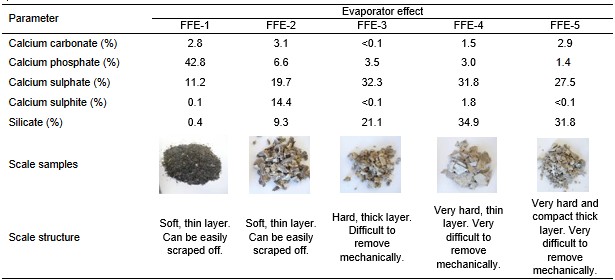
The analysis shows considerable differences between the individual evaporator effects. While calcium phosphate and sulphur-based compounds account for much of the scale in the early evaporator effects, calcium sulphate is found across all effects and silicates are deposited especially in the later effects. This is paralleled by the change in scale structure: in the early evaporator effects, the scale is soft and easy to remove, but in the later effects, very hard and compact layers form, which are very difficult to remove mechanically.
Cleaning as required by type of scale and operating conditions
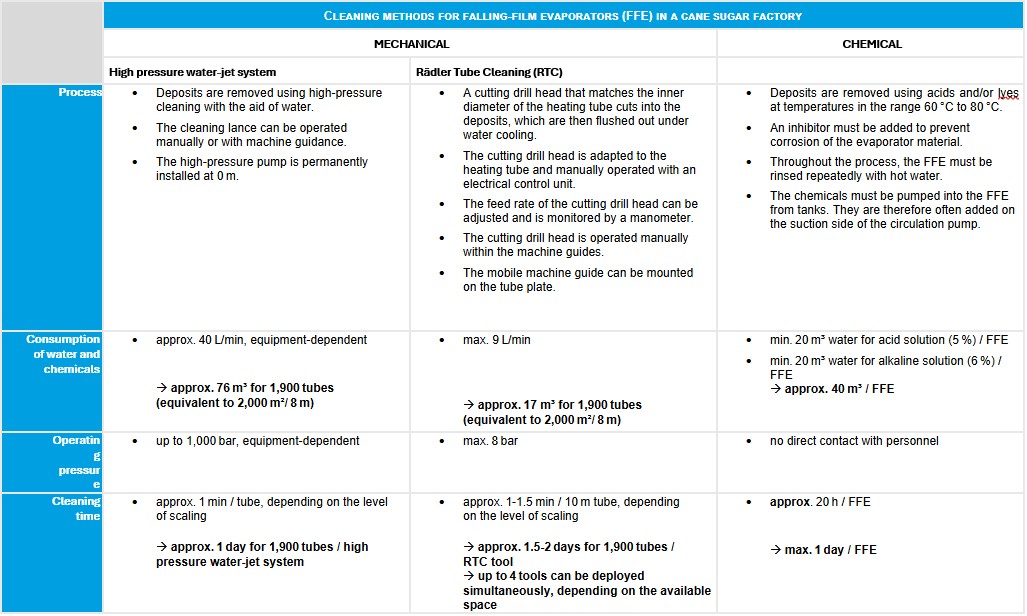
Depending on the factory, cane quality and the defecation process used, scale is removed from the inner surfaces of the tubes using chemical or mechanical cleaning methods, or both. Cleaning a falling-film evaporator requires access to the top tube plate, generally by opening the cover and removing the juice distributor. With a higher juice distributor dome as an alternative, the cover can stay closed and the juice distributor remain in the dome. The table below provides an overview of the different cleaning methods.
The impact of mechanical and chemical cleaning methods on the operational efficiency and cost of falling-film evaporators was the key topic in Dr. Omkar Thaval’s presentation at this year’s ASSCT conference (21–24 April 2026) in Mackay, Australia. Here are some impressions from the BMA conference stand.